
Tomorrow we set off for Tibet overland from Kathmandu. There are eight of us in this pilgrimage. Most of us have been long associated with Dharamshala, India, home of His Holiness the Dalai Lama and the Tibetan government in exile. We are therefore all old Dharamshala Wallahs. Although I originally wrote down who we were, second thoughts have caused me to erase the names. The chances of the Chinese authorities reading this are slim, but if they were to, they could easily identify the trip from the names and this could cause trouble for our guide and travel agent, both of whom could lose their licence to operate in Tibet. We have heard stories how Tibet guides had lost their licence for trivial but apparently anti-Chinese actions by their clients. As this blog contains material critical of the Chinese rule in Tibet, I think it better to take no chances. Maybe I am being overly cautious, but best to err on that side. The dates of the trip are also not mentioned.

Our original plan of going to Mount Kailash was scuppered by the refusal of the Chinese to grant permits to foreigners during the holy month of Saga Dawa. So instead we head for Lhasa, via Sakya and Tashi Lhunpo, and then south to Samye and elsewhere.
The border crossing at “Friendship Bridge” was painless, and much like border crossings elsewhere. However, our Tibet Guide by Stephen Batchelor was confiscated because of the forward written by the Dalai Lama. We had actually torn out the forward, but the caption, “Forward by HH the Dalai Lama” was still on the front cover. We were told we would not be getting it back. We spent our first night in Nyalam - not a pleasant town.
 |
| Main street in Nyalam |
 |
Mantras amid the rubble in Nyalam
|
Day 2, Milarepa’s Cave
 |
The next day we visited Milarepa's cave close to Nyalam. By now the scenery was breath-taking. The cave has been enclosed by a temple, and is quite a large cave. We sat there contemplating for a while. I thought of how this great yogi had totally renounced the world and its belongings, and what this meant in today’s world. It struck me how impossible it would be to live like him these days. The very idea of having nothing to do with international travel, money affairs, houses, computers, cars, and the like, is nothing but a dream for us. But I did try to imagine it, and saw for a brief moment how focused and profound such a life would be.
 |
| View of the valley from Milarepa's cave |
 |
| Inside the cave |
We traveled on toward Sakya and in doing so crossed over two high passes. It was there the wooziness and breathlessness began. At the hotel in Sakya a couple of people threw up, and a few had headaches, but we were basically OK.

 |
| The high passes are strewn with prayer flags |
 |
| High pass on the way to Shigatse |
Day 3, Sakya Monastery

 Sakya Monastery was founded in the 11th century by Khön Könchok Gyalpo, who regarded the pale coloured soil and flowing waters of the region to be an ideal site for a monastery. In the beginning it was a small monastery, but later in the 13th century when the Sakya master, Drogön Pakpa, was granted rule over Tibet, it assumed greater importance and expanded greatly.
 The main assembly hall is supported by enormous wooden pillars that resemble fossilized trees. We were told they were brought from the land of the nāgas. This being our first monastery, the sacred images were impressive. Large and dominating, they commanded awe and respect. They are mostly Buddha statues containing relics of former Sakya masters. Also, there was a beautiful statue of Mañjuśrī designed by Sakya Pandit, regarded as a manifestation of Mañjuśrī. Other chapels contain equally impressive images of lamas and deities, and protectors such as Mahākāla, Ekajati, and Palden Lhamo.
 Along the back wall of the assembly hall, and behind the main images is a vast collection of scriptures covering the entire wall and reaching to the roof. It is known as the Wall of Scriptures. Walking under it, I tried to imagine the knowledge that this entire collection held entering and filling my mind. In fact Sakya Monastery houses one of the finest collection scriptures in Tibet, including many written in gold and silver ink, as well as Chinese scriptures dating back to the early dynasties. There is one enormous scripture that takes four men to lift.
 |
| Old and new thermos at Sakya |
Day 4, Narthang Monastery and Tashi Lhünpo Monastery
 |
| Wooden print blocks at Narthang |
On the way to Shigatsé we stopped to visit the small and delightful Narthang Monastery. Narthang is the most well-known of the old Kadampa monasteries, and was founded in the 12th century by Lodrö Drakpa, as disciple of the well-known Kadampa Geshé Sharawa.
 |
| Shrine room at Narthang |
In the 13th century Narthang was patronised by the great scholar Chomden Raldri who together with Losal Sangyé Büm collected editions of the Kangyur and Tengyur (the collected teachings of the Buddha and their Indian commentaries) from all over Tibet and brought them to Narthang. In the 18th century Sönam Topgyal sponsored the production of wooden print blocks for the Kangyur and Tengyur. Thus the Narthang printing press was born. Many times I had heard of the Narthang Kangyur alongside the more well-known editions such as the Degé Kangyur. And to actually see it was a joy. Again I was amazed at how small it was; just one small room, its walls and shelves stacked high with printing blocks. The monks assured me it was still in use, but I can’t help thinking that digital printing has taken over.
 |
| Printing blocks at Narthang |
The images there include a Maitreya statue made from medicinal clay brought from Bodhgaya. There are also many scroll paintings dating back to early Chinese dynasties. Although we visited larger and more impressive monasteries, little Narthang impressed me greatly.
 |
| Stupa at Narthang |
Tashi Lhünpo Monastery is in Shigatsé, Tibet’s second largest city. This was our first large town, and clearly we were driving into a busy, prosperous city, with the large Tashi Lhünpo monastery at its centre. What a difference to little Narthang, and even Sakya. Shigatsé resembles cities everywhere in China, with its wide streets, well-stocked shops, and the kind of impersonal and characterless feel that many newly expanded cities display. Even the hotel we stayed in had a foyer the size of a supermarket. Everything was exaggerated for the sake of effect. Still, for the first time we had access to the internet and good restaurants.
 |
| Tashi Lhunpo |
 We went from one chapel to another, most of them hosting shrines to the previous Panchen Lamas, including the famous fourth, Chökyi Gyaltsen. There is also a shrine to the tenth Panchen Lama, Chökyi Gyaltsen, who died in 1989 and was the subject of much speculation over his relations with China, and even over his selection as the true incarnation. He spent a lot of time in China and in his early life was seen as an ally of China against the Lhasa government. However, his criticisms of the treatment of Tibetans led to his imprisonment in the late 60s. After his release in the 70s he married a Chinese woman, and openly supported Tibet, especially in his last speech in Tibet in 1989. Shortly after he died here in Tashi Lhünpo.
As there was with the tenth, there is a dispute over the eleventh incarnation. The Chinese government rejected the incarnation chosen by the Dharamshala government and have imposed their own incarnation on the Tibetan people. The whereabouts of Chökyi Nyima, the boy chosen by HH the Dalai Lama are unknown.
 |
| Tashi Lhunpo |
 |
| Shigatse restaurant |
 |
| Pilgrims |
 Just outside Shigatsé is the small monastery of Shalu, built in the early 11th century by Sherap Jungné. In the 14th century Butön Rinchen Drup (Butön Rinpoché) extended the monastery and established the monastic community there. He is very much associated with Shalu, and renowned as a great Kālacakra Tantra scholar. The assembly hall contains a Kālacakra deity statue built by him, a self-arisen mani stone, an Avalokiteśvara brought from Bodhgaya, a speaking Avalokiteśvara, and a self-blowing conch!
Like Narthang, Shalu impressed me greatly. I had heard of it many times in association with Butön Rinpoché, but like Narthang I was surprised how small it was.
Gyangtse is a small and friendly town, famous for its wonderful Kubüm shrine of 108 chapels. It is an exhausting trip to visit all 108, and I for one did not finish it. The adjacent Pelkor Chödé monastery contains a speaking Tara, a protector chapel containing Ekajati and Mahākāla, and other chapels for the sixteen Arhats, Medicine Buddhas, Mahāsiddhas and much more.
 |
| Gyangtse Kubum |
Turning off this road, we were at once thrust into the backstreets of the Barkor. Though recognizable as the Tibetan old town, the antique shops for tourists were all too evident. Nobody wants a return to the quaint old Tibet of the pre-1959 invasion, but there is a sadness in a town so dreadfully reliant on the wealth of foreigners. It is as if the town has lost its pride and self-respect.
 |
| The Barkor |
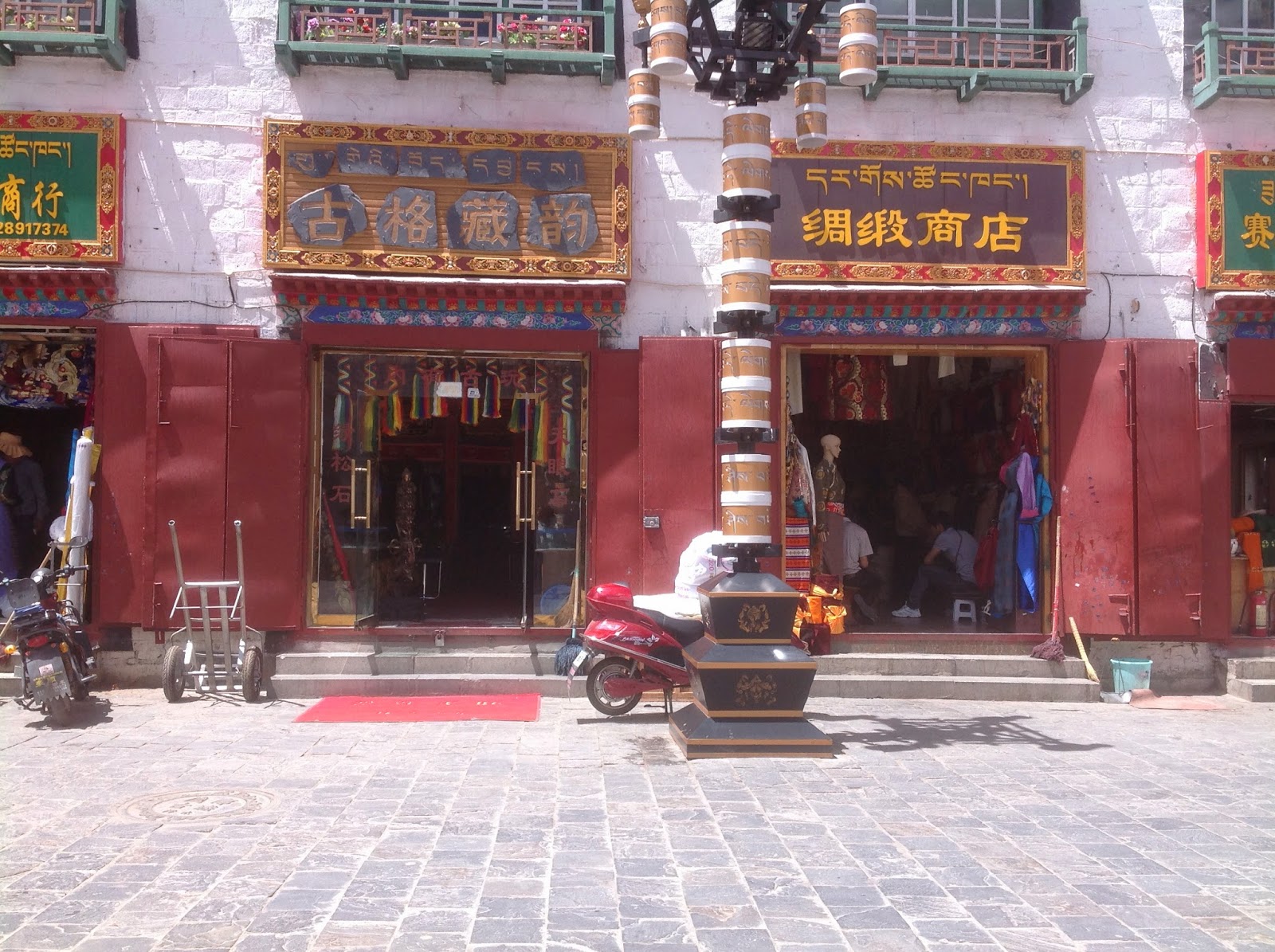 |
| Shops on the Barkor - smaller writing in Tibetan, larger in Chinese |
We went first to a little nunnery on one of the many side streets in the Barkor district. I noticed that a few of the smaller alleys had been blocked up by the Chinese. Too tempting a place for an ambush maybe. The Chinese fear borders on paranoia sometimes. A nun summoned the others to assembly by blowing on a white conch shell. They dutifully arrived and took their seats in the assembly hall. In another part of the nunnery nuns were busy making the sacred substances to place inside of statues as we tourists filed by. It is difficult to gauge their inner reaction to this intrusion. They all behave gracefully and showed nothing but friendship. Maybe they accept it as a necessary nuisance. After all the tourist pay entrance fees and so support the nuns.
Arriving at the Jokhang square we passed through a security check post manned by policemen with machine guns.
Entering the dark mystical world of the Jokhang we were flanked by two huge protector statues. Inside we walked around in awe of the sacred objects in the many chapels sunk into the walls. This temple was built in the seventh century by the Tibetan king Songtsen Gampo, and is revered throughout Tibet. Among the many statues is one of Je Tsongkhapa, the 14th century reformer and founder of the dominant Geluk school of Tibetan Buddhism, known as “the statue that looks like me,” a reference to a remark made by Tsongkhapa himself. Other chapels include more statues of Tsongkhapa and his eight chief disciples, as well as the chapel of the Indian master Atiśa who came to Tibet in the eleventh century and his disciples Dromtönpa and Nakpo Lotsawa. How wonderful it was to be able to express our gratitude to Atiśa for bringing the Lamrim lineage to Tibet.
 |
| Entrance to Jokhang |
The temple was full of Chinese tourists who express their faith with a bobbing movement of their hands in a prayer gesture. Someone said that they were there seeking good luck and fortune for themselves, and that their faith cannot be compared to the deep respect and devotion shown by the Tibetan pilgrims. Maybe. It is hard to tell. I could not help but wonder what they were feeling, and how much they knew about Tibetan Buddhism. How strange it is that their own government has been responsible for so much terror and oppression of the Tibetan people, and yet they flock to these sacred sites to worship the very deities that the Tibetan people have made their own. Maybe they truly believe that Tibet was always a part of China, and therefore the Buddhism of Tibet belongs to them also. Many people say that the hope for the Tibetan people lies with their Chinese counterparts. Certainly more young Chinese have expressed their faith in Buddhism. China, after all, was a Buddhist country. However, whether this is some exotic fashion or proves to be a longer lasting phenomenon remains to be seen.
 |
| Private rooms for the Dalai Lamas at the Jokhang |
After a tour of the chapel of the Jokhang, we went on to the roof. There we had our first real view of the magnificent Potala. Last night as we drove into Lhasa, we caught our first glimpse of the Potala. It was lit up like a Christmas tree. It seemed so incongruous amid this neon bathed city, as if someone had photo-shopped it in. But now it was a reality as it stood head and shoulders above the town.
 |
| On the roof of the Jokhang with Potala in the background |
Suddenly our earnest Tibetan guide ran over and told us that we had gotten permission to enter the private quarters of the Dalai Lamas here on the roof of the Jokhang. This was a rare opportunity, as these chambers were often closed to the public. We were quickly ushered inside so as not to attract the attention of the Chinese tourists on the roof, who were anyway preoccupied with striking strange poses for photos. Inside we gazed upon the teaching rooms where Dalai Lamas from the 5th onwards had given teachings to a select few. We sat there for a few moments trying to recreate and relive those special moments. We then visited the Dalai Lamas’ meditation room and the small room where they exchanged one-to-one teachings with other lamas. What a privilege to stand in the room where the Great Fifth had sat, where he had walked, and where he had meditated. It almost felt like an intrusion.
 |
| Chinese "lama" on Jokhang roof |
The attendant monk was very gracious and allowed us to stay longer than he had intended. We told him that tomorrow we would bring him some blessed Mani pills and blessing cords we had brought from Dharamshala.
What a strange contradiction there is in this city. The controlling Chinese authorities must know that all Tibetans carry great love for the present Dalai Lama. Although his picture and name is banned, he is here in other ways. Every Tibetan altar that shows a picture of the Potala, a painting of Avalokiteśvara, or the Mani mantra is in reality showing a picture of the Dalai Lama. The Potala is where he lived, he is regarded as Avalokiteśvara in human form, and the Mani mantra is the mantra of Avalokiteśvara. The authorities must know this, and yet they persist in this charade of obliterating any representation of him at all. Even their own people, the ordinary Chinese, have faith in the very religion that he is the pinnacle of. How on earth does that make any sense? How do they reconcile this contradiction? Probably they do not. They just follow orders.
Day 7, Potala
The circumambulation route around the Potala was thronged with Tibetan pilgrims from all over Tibet. It was a constant conveyor belt of the faithful. Silent and steadfastly they made their way around this large representation of the Dalai Lamas, past and present. Every few yards stood a trio of Chinese police: one with a riot shield, one with a machine gun, and one with a baton. They stood there with sunglasses on, their backs turned to one another in a triangular formation, like a three-headed wrathful protector. What struck me was how young they were. Just kids really. Get them young and indoctrinate them. That way they obey without question.

The steps up to the Potala are long and the weather was hot. I thought of the many great lamas who had made their way up these steps in the past, in order to give and receive teachings from the Dalai Lamas. Now these same steps were filled with Chinese pilgrims led by shrill-voiced Chinese tourist guides.
The progress through the many rooms and chambers was not particularly pleasant. The stairs were steep and we were constantly being carried along the narrow corridors by the throng of Chinese. All in all, the visit to the Potala was less than fulfilling. This had been the residence of the Dalai lamas since the 5th in the 17th century, and this mad rush through their apartments (we had to be out within an hour) felt like a rude intrusion into a private realm. There was no time for reflection.
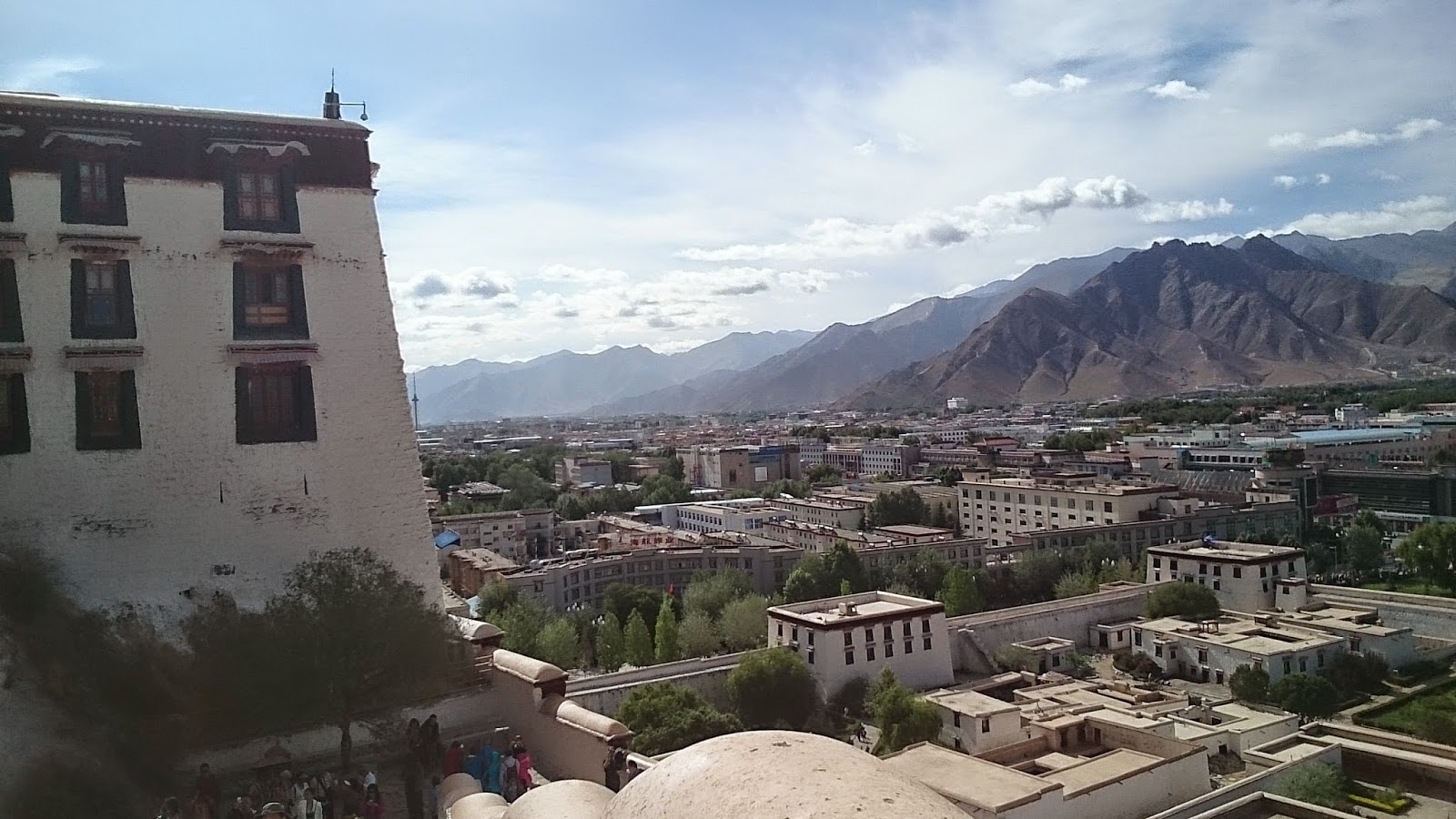 |
| Lhasa from the Potala |
 |
| Lhasa from the Potala |
Sera was disappointing. It has lost the feel of the once great monastery it used to be. It was largely destroyed during the madness of the Cultural Revolution. It is being rebuilt, but now there seems to be more tourists than monks. This is largely because the Chinese have restricted numbers of monks. They know only too well what hotbeds of nationalistic fervour monasteries can become.
The saddest sight for me was that of the monks debating. I had trained in this dialectic way of learning Buddhist philosophy at Dharamshala, and I was looking forward to seeing it. I wanted to know if they still studied the same curriculum as they had done when Tibet was free. All three great Geluk seats of learning – Drepung, Sera and Ganden monasteries followed basically the same curriculum for hundreds of years, and it was being continued in the recreated monasteries in India. I walked eagerly to the debate ground when the gong sounded, and grabbed a monk on the way. They were indeed still pursuing the same curriculum, he said.
 |
| Chinese flag above Sera Monastery |
However, when I walked into the walled debate courtyard the sight that awaited me was shocking. A small area for debating was cordoned off by stern looking guards in uniform, while the perimeter was filled with tourists with cameras. The guards prevented anyone from encroaching on the debate area and uniformed guards watched at the gate.
 |
| More tourists than monks in Sera |
The whole thing was a show. I thought back on the stories my Dharamshala teachers, Geshé Rapten and Geshé Ngawang Dargyé, both of Sera Monastery, would tell us, of how they stayed up all night debating until their hands froze, but were so engrossed in the debate, they barely noticed the time passing and the intense cold. I was saddened by this spectacle I was watching. Of course, the monks could have been sincerely and intelligently engrossed in their debates, but I did not stay to find out.
 |
| Empty Sera |
On the way, I saw an ancient monk appear from a passageway. I asked him how long he had been at Sera. “A long time,” he replied. I told him that I was from Dharamshala and that I studied under Geshés Rapten and Dargyé. Did he know them? “No,” he replied. I said goodbye and walked on. But he called me back, and asked, “Is His Holiness the Dalai Lama well?”
Day 8, Drepung Monastery
At the gates of Drepung we all offered incense and then went inside. Here was what remained of the Ganden Podrang, the seats of the Dalai Lamas up to the Great Fifth, and the name given to the government of Tibet under his control. In the main assembly hall were statues of Je Tsongkhapa. In the Kunga Ra were the statues of the thousand Buddhas due to appear in the world in this eon. The main figure in the protector chapel was Palden Lhamo. The main temple housed a statue of a speaking Tsongkhapa. What would he have said about the present situation in Tibet?


 |
| Views of Drepung |
 Outside and further up the hill was the cave of Jamyang Chojé, disciple of Tsongkhapa, who founded Drepung in the 15th century under the direct instructions of Tsongkhapa. This was the first residence of Drepung and here Jamyang Chojé gave many teachings. Inside was a self-emanated mural of him.
Inside the main assembly hall resting against a statue of Tsongkhapa was a photo of Denma Lochö Rinpoché, a dear teacher who lives in Dharamshala, and of the previous Ling Rinpoché, tutor to the present Dalai Lama. This sight brought home to me that once these and other great lamas walked these dark corridors, sat and performed rituals in this assembly hall, gave teachings to the monks, debated and meditated. How deserted it all now seems. The mighty eagles have flown away and just their images, their spirits, and their echoes, remain.
 |
| Entrance to cave of Jamyang Choje |
 |
| Entrance to Drepung Loseling College |
Day 8, Norbulinga.
The Norbulinga is a large park in Lhasa. In the 16th century it was a beautiful wilderness populated by deer and birds. The 5th Dalai Lama would pitch camp there for picnics and relaxation. Later the 7th Dalai Lama built the first palace there, the Kalsang Palace, named after him. These days it is a well-cultivated, enclosed park. The gardens are well maintained, and the whole park resembles the grounds of a stately home in England. The various palaces there have an almost modern feel, and are light and fresh when compared to the dark, poorly-lit rooms of the monasteries we visited.

The Chensel Palace constructed for the 13th Dalai Lama contains a selection of carriages designed to be pulled by horse or man, reminiscent of those used by the Queen on state occasions.

In the palace built for the 14th Dalai Lama there is a mural containing a depiction of the Dalai Lama as a young man. This was the first time we had seen his portrait in Tibet. How did the Chinese miss this one! In another room there was a very early piano; a gift to the Dalai Lama from Pandit Nehru, prime minister of India.


Day 9, Ganden Monastery. Ganden is forty kilometres east of Lhasa on Drokri Mountain at a height of 4,000 metres. It was founded by Tsongkhapa in 1409. He travelled much, always taking many disciples with him, but they had no permanent home. After a while Tsongkhapa decided they needed a new monastery. Divinations were made in the presence of the Jowo statue in the Lhasa Jokhang, and Drokri Mountain was decided upon. This mountain was mentioned by the Buddha many times, and it is said that it was visited by Maugalanya, a disciple of the Buddha, who hid a white conch shell there. This conch was later unearthed by Tsongkhapa, who eventually gave it to Jamyang Chojé, the founder of Drepung.

 |
| The reconstructed Ganden |
On arriving we decided to do a circumambulation. The route around the monastery circles the mountain and offers stunning views of the Kyichu valley. The path is narrow and because the altitude made us dizzy and often breathless, we had to take care as we walked round. Every few metres a modern stone plaque announced a particular self-emanation in the rocks above. These were of various deities, protectors, and even scenes of Buddha’s birth. However, try as I may, I could not see any of them.
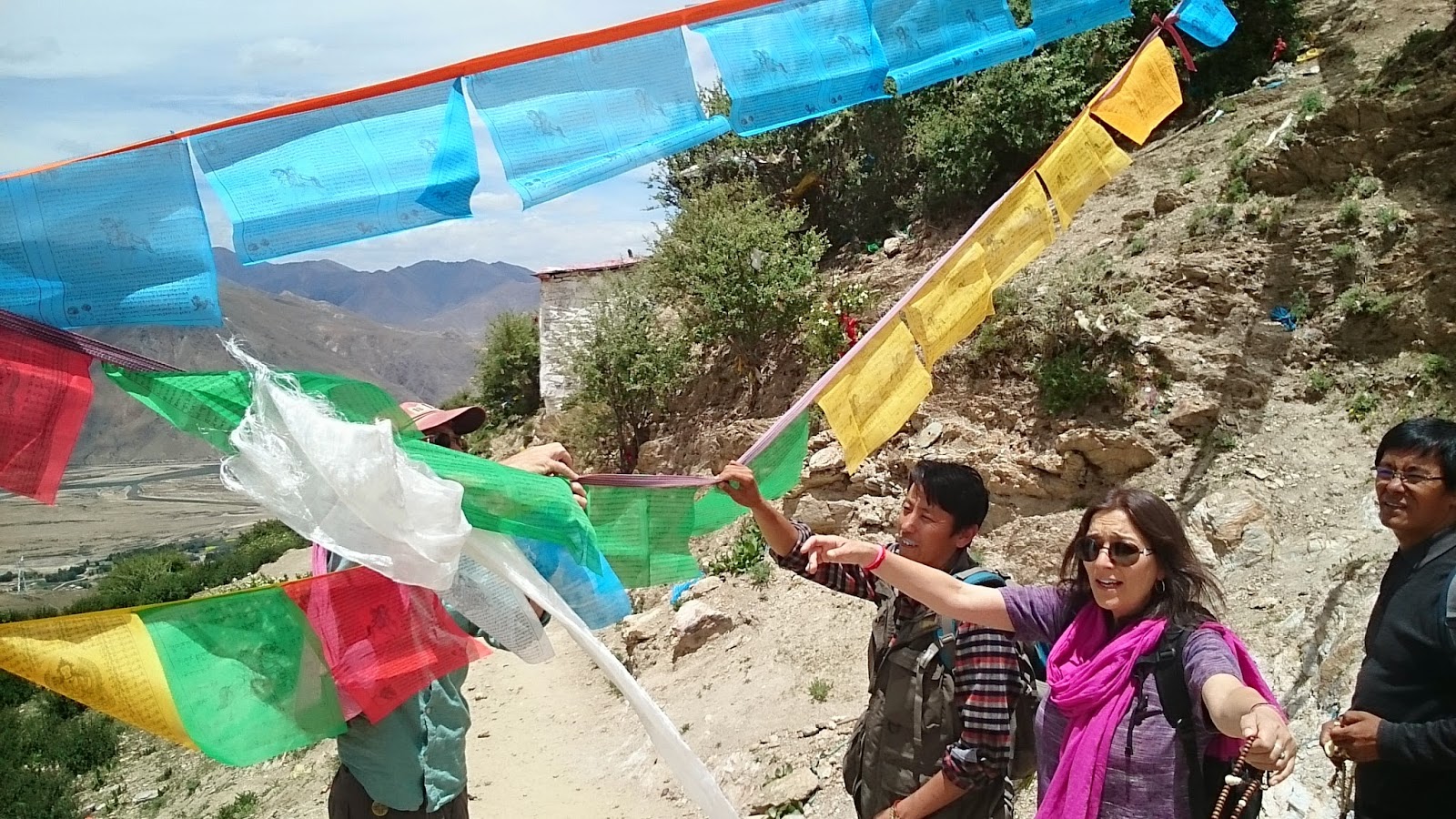 |
| Offering prayer flags on the Ganden Korwa |
 |
| View from Ganden |
Towards the end of the route is Tsongkhapa’s cave. Inside is a self-emanated statue of the great man. This one I could see.
When I am in the presence of the statues, self-emanated or not, of these extraordinary beings, I try to imbibe the spirit or blessings given off by the statues, and try to recreate the time when these great beings occupied these places. It is not an easy practice, and is often tiring. Still, it is a source of wonder to be in the same place where such beings, whose works we have studied, whose teachings we have attempted to practice, whose mantras we have recited, and whose blessings we have sought, actually once stood. Je Tsongkhapa was a man, and he sat in this very cave, walked this floor, and developed insight after insight here in this place.
Day 9, the trek
We started our three-day trek to Samyé Monastery from Drupshi, a village a few kilometres from Ganden. There the yaks were waiting to be loaded. Nervous and yet somehow proud and slightly fierce looking, they stood patiently as our bags were loaded upon them. Something made me feel slightly embarrassed as these noble beasts were laden down with our western paraphernalia. Here we were in their country dictating their course for the next few days and presuming that they would simply do our bidding.
 |
| Loading the yaks |
We set off full of expectation and excitement. The first camp was a few hours away, and was not too difficult to reach. We were provided with tents and an evening meal cooked by our intrepid cook who made this trek regularly. He and his three helpers bedded down together in their kitchen tent as we unpacked our expensive 4-season sleeping bags and put on our Peter Storm thermals.
Breakfast was simple but welcome. The yaks were reloaded and off we set again. Now it was different. We were heading for a 5,000 metre pass. The breathlessness kicked in and we felt dizzy. We had acclimatized somewhat but nothing could be done about this. Our steps became laboured and our gasps were audible. Often I thought I could not make it. But the trick is not to look up, and just concentrate on putting one foot in front of the other. I felt like some very old person who has difficulty in walking. But of course we made it to the top of the pass, where we collapsed amid the prayer flags and ate our meagre packed lunch.
 |
| The yaks do all the work |
 |
| Some get left behind |

On the descent we could see the camp site up ahead; a green patch of land with nomad tents scattered around. These tents were black, smoke drifting lazily from their tops, a large fierce dog barking outside, and surprisingly, solar panels on their sun facing sides. Maybe they had TV inside.
That night we slept fitfully, awoken by our own breathlessness, and once or twice by the sound of yaks munching outside the tents. But we were well, and that evening had nourished ourselves with some excellent Laphroaig single malt.
 |
| In the food tent |
 |
| Exhausted at the top of the pass |


 |
| Mountain flowers on the trek |
The next day consisted of a few hours walk along the river. Behind us rain clouds gathered and threatened to spoil our walk, but they held off, and we arrived at Yamalung, the end of the trek.
Day 12, Yamalung and Samyé
Yamalung is a sacred place 25 kilometres north of Samyé, along a valley through which runs a tributary of the Yarlung Tsangpo, or Brahmaputra. It is a delightful spot to end a trek. The tiny town is flanked by green meadows on which donkeys and horses were grazing. On either side the slopes of the river valley rose high. It was here in a cave that Padma Sambhava, in order to provide a long life for the young king Trisong Detsen, opened a mandala of Amitāyus, the deity of longevity, and took out a pot of elixir. In the ensuing month-long longevity rituals, Amitāyus appeared above the pot in the form of rainbow light, saying “Whoever drinks this will live for seven thousand years.” Later, this pot was recovered as a treasure by Terdak Lingpa, and its contents are still benefitting people to this day.
 |
| Donkeys on the bridge at Yamalung |
 |
| Yamalung hermitage |
After lunch the cars arrived to take us to Samyé. The yaks were relieved of their loads and trotted back obediently up the pass.
The approach south to Samyé from Yamalung is spectacular. The Brahmaputra valley was spread out in front of us in its majestic green fertility. In the middle of the valley and directly in front of us stood the sacred Hepo Hill, one of four sacred hills in Tibet. It is said to resemble a lion reaching for the skies, a sleeping elephant, and from the front it has the shape of the eight auspicious signs. It was on this hill that Padma Sambhava subdued the demons that were causing havoc in the construction of Samyé Monastery.
 |
| Samye Monastery |

 |
| Samye grounds |
 |
| Samye assembly hall |
 |
| Samye entrance |
Outside the central building is an inner circumambulation route that reeks with antiquity. Bounded on one side by the high walls of the monastery and by dark cloisters on the other, it immediately takes you back to those ancient times, and you can easily imagine hunched figures of those time walking along muttering their mantras.
Outside, in the grounds and situated at the four directions, stand four stupas, coloured red, white, green and black. I thought these represented the four directions, but I was told by a monk that they represent the four types of tantric activity – wrathful, pacifying, increase and controlling. However, I read later that they are stupas dedicated to four protectors.

 |
| Grounds of Samye |
Also outside are two temples representing the sun and the moon. Inside the moon temple a tailor was busily sewing scripture cloths. He and the temple caretaker asked me for blessed pills and protection cords blessed by the Dalai Lama in India, which we happily gave.
Day 13, Chimpu Caves
Chimpu is a sacred site situated on a steep slope of the Yarlung valley about fifteen kilometres north-east of Samyé. It has many caves, temples and self-emanated sites. It is described as outwardly resembling an open lotus and inwardly resembling the Vajra Varahī mandala source. In its centre is the Drakmar Keutshang (Red Rock Cave) where Padma Sambhava gave his very first initiations and tantric teachings in Tibet. Below this cave in Secret Flower Rock is the cave of Jikmé Lingpa where he received visions of Longchen Rapjampa.
 |
| View of Brahmaputra from Chimpu |
 |
| View from Red Rock Cave |
 |
| Mani stones at Chimpu |
 |
| Jigme Lingpa's cave |
Above the temple was the cave of the eighth century early-transmission translator Vairocana. As a young man he trained in Sanskrit and translation techniques under the auspices of King Trisong Detsen, before being sent to India to bring back Buddhist scriptures for the dissemination of Buddhism in Tibet. He is credited with bringing back the Dzokchen texts. This cave was reached by crawling through a dark entrance and down to the cave below. This particular cave left a strong impression upon us.
On the long way down we visited a cave where Padma Sambhava manifested as a Garuda hawk in order to tame the nāgas of the valley. Dust from this cave protects one from the harm of nāgas. We managed to gather a small bagful.
According to the literature there are so many sacred sites in Chimpu, but some were destroyed by the so-called Cultural Revolution, and others we did not find.
 |
| Temple at Red Rock Cave |
 |
| Stupa at Chimpu |
 |
| Prayer flags at Chimpu |
 |
| Red Rock Cave temple |
 |
| Inside Vairocana's cave |
 |
| Nuns at Chimpu Nunnery |
Day 15, Yumbulakhang and Tradruk Temple
The famous Yumbulakhang tower is probably one of the most photographed sites in Tibet. It is said to be the first royal residence of Tibet, and the palace of one the early kings of Tibet, Nyatri Tsenpo.

It stands just outside the town of Tsetang, a Chinese military town. Many Chinese live here and many Chinese businesses can be seen. Although the Chinese we have met have all been very friendly, the young shop assistants in the supermarkets and elsewhere often display a giggling dismissal of foreigners. Often they made no attempt to understand what we were looking for. It was not quite insolence. To us it seemed like plain hopelessness.
Yumbulakhang is perched high on a rock outside Tsetang, and is a short but steep walk. It is small and does not take long to visit. It hosts a beautiful standing Avalokiteśvara.
 |
| Cat at Yumbulakhang |
 |
| In the courtyard at Traduk Temple |
 |
| Mural at Traduk Temple |
 |
| Masks at Traduk Temple |
On the top floor is the famous pearl depiction of Padmapani Avalokiteśvara. He is shown in a relaxed and natural pose, with one foot on the ground and his head tilted to one side. The painting is made entirely of pearls, estimated at 29,000.. On his face is the sweetest of smiles. Next to it is a tapestry woven by Wengchen, the king’s Chinese queen.
Day 16, Olkha Chölung
Today we drove for two hours east of Tsetang along a dirt road to Olkha Chölung Monastery. Here Je Tsongkhapa spent three years from the age of thirty-six with his eight main disciples. I had wanted to come here because I had read in many colophons to Je Tsongkhapa’s works the words, “Composed in Olkha Chölung….”
 |
| The small courtyard at Cholung Monastery |

The monastery is across the Chölung Valley from the small town of Olkha and offers beautiful views of the valley. We were greeted by a young and very helpful monk who opted to be our guide. He first showed us the flat stone that Tsongkhapa used to offer his 3.5 million mandalas. Blood trickled from his arm onto the stone as he rubbed its base each time he offered a mandala, forming many self-emanated images of deities and sacred letters. On the altar in the same room is a statue of Maitreya built according to the description given by Tsongkhapa when he received a vision of him.
 |
| Stone Tsongkhapa used for his mandala offerings |
 |
| Tsongkhapa's footprint |
We were then taken to room where he slept. It was surprisingly small and dark. On one wall there is a painting of him. The story is that he sat on the other side of the room while it was being painted. “Make it like me,” he said. After the painting was finished light radiated from Je Tsongkhapa’s heart into the painting, and then light came from the painting and absorbed into Je Tsongkhapa.
Behind the monastery is his cave, which was not much more than a small opening in a rock. Above the cave and in the open is a stone throne from which he gave teachings. Further on is a cave, which we did not have time to visit, where he composed his Praise to Dependent Arising, and his beautiful prayer to Śākyamuni Buddha. Nearby is a river whose sound resembles the mantra of Mañjuśrī.
 |
| Inside Tsongkhapa's cave |
 |
| Tsongkhapa's throne |
In the monastery courtyard is another throne where Tsongkhapa and subsequent Dalai Lamas gave teachings. Hanging in courtyard entrance is a dead horse that belonged to the lama of the monastery. It was a strange sight to see this corpse several feet off the ground. After it had died a horn grew out of its head, just above its ear.
 |
| The lama's dead horse |
A little further on is another small temple founded by Sönam Lodrö, a disciple of Tsongkhapa. It contains many votive images of Amitābha made by Tsongkhapa himself.
Day 18, Everest Base Camp
We drove back to Shigatsé, and the following day headed for Everest base camp. This is reached by turning off at Dingri and driving for three hours along a bumpy and dusty road through barren landscape, which at times resembled a moonscape – nothing but stones and rocks. Base camp is at Rongpu, and is equally isolated. Yet even here, there is a Chinese military presence, who feel the need to keep a close watch on everyone. There is a route into Nepal here, and maybe they are keeping an eye open for escapees. Once again permits had to be checked, and passports scrutinized.
Rongpu is at a high altitude, and our breathlessness returned. We stayed at the basic guest house. The food was also very basic. Breakfast was either omelette or pancake, with no bread. So we devised a new breakfast – omelette on pancake. Still, the rooms had very heavy duvets and electric blankets! They were the snuggest of the many hotel rooms we stayed in.
Still, the main attraction – Jomo Langma, as Everest is known – was what we had come to see, and she was hiding behind the clouds. We had to wait until the next morning to see this mountain in all its glory. And what glory it was. The tallest mountain in the world rising in front of us in true majesty.


Day 20, The way back
After two nights in Rongpu, we headed back to Dingri, and on to Jangmu, the border town where we spent out last night in Tibet. By now we were all looking forward to dropping down a few thousand metres, being able to eat rice and dal again, and off course, being able to speak freely about the Chinese occupation of Tibet, and the Dalai Lama, without having to look over our shoulders. It had been a fantastic trip, and we could not have asked for more. Our Sherpa and Tibetan guides had been reliable and trustworthy. Our heads were swirling with memories – some sad, some joyful – as we crossed the misnamed Friendship Bridge to Nepal, and travelled on to our hotel in Kathmandu.
The situation in Tibet
 Not having been to Tibet before, I had built up a multitude of impressions of what it would be like. Some of those impressions were reinforced. Some were weakened by the actual experience of being there.
One Chinese professor from Shanghai recently said, “The Communist Party is like God. It is everywhere. You just can’t see it.” I think that is the overall impression of Chinese rule in Tibet I gained. It is the rule of the iron fist, tightly gripping all it sees. Yet you never see who the fist belongs to. We came up against many illustrations of this tight control. To cite just a few:
No foreigner can travel in Tibet without a guide. This guide must be organized before entering the country. Whether traveling alone or in a group, a guide is mandatory. This does not mean that the guide has to follow the tourists as they wander through the streets of the towns, but they must organize and report the itinerary to the authorities regularly at check points positioned along the main highways.
As well as a guide and a Chinese visa, permits must be obtained for the trip in general and for many of the areas to be visited. The entire trip itinerary together with names and passport numbers must be submitted to the authorities and on no account must it be diverted from. For example, one of our group was sick and considered flying back to Kathmandu from Lhasa. This would have meant reapplying for an adjustment of the whole itinerary, requesting for one name to be removed from the list, and applying for a permit for that person to leave the country early. You cannot just book a flight, take a taxi to the airport, and leave.
For Tibetan it is worse. In the so-called Tibet Autonomous Region they cannot move or travel from town or region to another without permission. A Tibetan from Shigatsé wanting to visit relatives in Lhasa must apply to the authorities for permission to do so. And this in their own country. Moreover, if a Tibetan has a relative to stay in their house, they must notify the Chinese of that visit. This is just one of the freedoms curtailed in the TAR. Freedom of movement is a fundamental human right, and it is being denied.
Since 2008 it has become very difficult for Tibetans to get a visa for India. One woman whose uncle is in Dharamsala told me she can no longer visit India because of her past trips abroad, and even suggested that her son, who had done excellently at school, was being denied the opportunities to pursue his chosen career because of his mother’s connections with people outside Tibet.
Everywhere we went there were permits to check, passports to show, and places we were not allowed to visit for no apparent reason. The beautiful Lama Latsho Lake with its prognostic abilities was suddenly out of bounds for tourists over the month of Saga Dawa. Why? What possible threat to national security could a lake pose?
Control was everything. People watched us closely as we thronged through the Potala alongside hundreds of Chinese tourists/pilgrims. Once in a street in Lhasa, a Tibetan shopper was arguing with a Chinese stallholder over the price. Within minutes a plain-clothes security official arrived from nowhere to sort it out.
Even at Everest base camp, miles from any political centre, and a haven of peace and tranquillity, checkpoints were in evidence. You couldn’t do this. You couldn’t do that. You cannot even walk alone from the guest house to the base camp tents.
Young military officers are everywhere. Some are pleasant, others are officious. Most carry guns. Most look about seventeen years old. In Lhasa there is a police check post every hundred metres or so.
As we approached the full moon of Saga Dawa, lines of army trucks appeared on the streets, each with lines of baby-faced soldiers facing to the outside of the truck, machine gun in hand, just waiting for trouble to begin.
The Chinese system functions by way of a tight control over its citizens. Although outwardly it has the appearance of a rampant capitalistic set up, behind the scene its operation comes straight out of the old Soviet model handbook. This is made clear in the excellent book, The Party: The Secret World of China’s Communist Rulers, by Richard McGregor. Centralization and control of all aspects of life is the driving force. It does not matter if individuals (the relatives of the Tibetan self-immolators, for example) get hurt. The system comes first. What does it matter if a few ants die as long as the ant colony is preserved? Public opinion is to be controlled and if necessary repressed, all in name of the continuation of the Communist Party and its principles of survival. Survival is at the very heart of the Communist Party’s thinking. Devoid of any mandate from the people, it must exercise an iron will to survive, at any cost.
The Tibetan people are victims of this repressive system. They are not regarded as a race of people whose sensitivities and needs are to be listened to, but as people of the Motherland who must fit in with the Communist Party’s will. Anything other than that is unpatriotic at the least and treachery at the worst. Appealing to the better nature of the Party is futile. Any “better nature” is subsumed into the overbearing might of the need to control.
And why not? This systematic control has brought huge economic success over the past few years. Why fix it if it ain’t broke? Once, when challenged by a persistent American politician over dinner in the USA, on how China could possibly reconcile its “communism” with the rampant capitalism taking place in China, an irritated Chinese official replied, “We are the Communist Party. We will decide what communism is.” It says it all.

Take the issue of the Dalai Lama. No photo of him is allowed anywhere in Tibet. No book, no video, nothing that carries his name is allowed. This is a deliberate attempt to wipe his name from the consciousness of the Tibetan people. The Communist Party knows full well that the Tibetan people love and adore him. They know, or at least they should know, that he is not a “terrorist” or a “wolf in sheep’s clothing.” And yet they pursue this cruel policy. Why? Control. By separating the Tibetan people from someone they can rally around they hope to extinguish any sparks of rebellion or protest, thereby forcing the people to the will of the almighty Communist Party. Sympathy for the Tibetan people bereft of their beloved leader is not an issue to be considered. The Party comes first and last. The self-immolators and their families deserve no pity, no understanding, because their actions threaten the unity of the Motherland. Therefore, they are treated with harshness instead of understanding.
When the current Chinese president, Xi Jinping, was visiting Europe recently he said, in response to a question about the Chinese government’s lack of care for the Tibetan people, “The Chinese government cares more for the Tibetan people than the international community does.” From one point of view he was correct. The government has poured billions of yuan into Tibet to bolster its economy, improve infrastructure, and provide services. There are even stories of the government building homes for Tibetans willing to return from exile, and of giving them jobs and money. Monasteries are being rebuilt, hospital and schools are constructed where there were none before. The improvement in Tibet is undeniable. The country resembles a large construction site. This is what the president meant when he said the government cares for Tibetans.
What the questioner, and possibly the international community, means by “caring for Tibetans” however is something different. It means cementing their basic human rights, restoring the power that was taken from them by Mao, and giving back their freedoms they have been denied.
I do not know how most Tibetans would react if given a choice between economic improvement of their lifestyle in the form of jobs and housing on one hand, and a restoration of the freedoms and powers they once enjoyed. Maybe many would pragmatically opt for the former over the latter. What is for sure is that they cannot have both.
But regardless of personal preference, the right to be able to move as you please, worship as you please, speak as freely as you please, to have the autonomy that your people deserve, to be able to stand up against injustice, oppression and occupation from an alien invading force, is the fundamental right of every being on the planet.
The Tibetan people deserve this. They are denied it. This is the struggle. It is not built on hate, ideology, nationalism, religious bigotry, or even a nostalgia for the past. It stems from the pursuit of justice and fairness, and for everything that is decent in this world.
Long may the Tibetan people survive. Long may they stand firm against the tyranny cast over them, and may truth, justice and liberty prevail. Bö gyal lo! Bö gyal lo! Bö gyal lö!


